



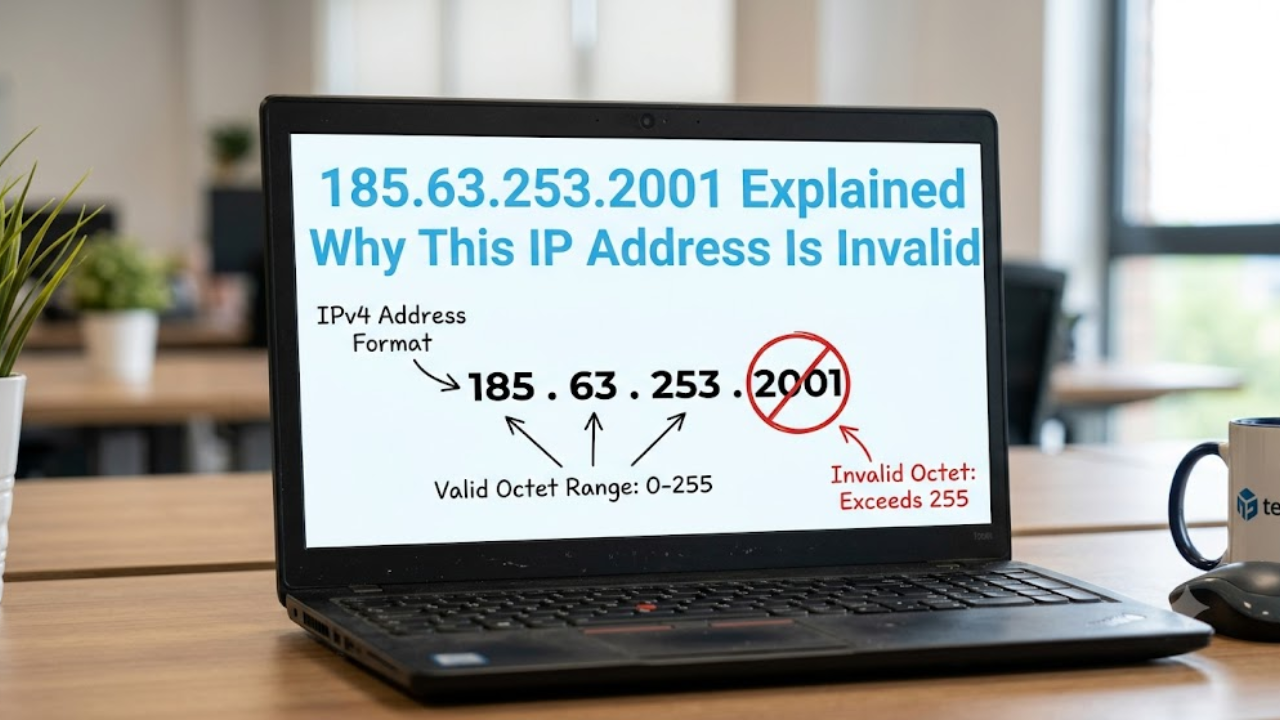
The keyword 185.63.253.2001 may appear to be a normal IP address, but it actually contains a formatting problem that makes it invalid under standard IPv4 rules. Many people come across strings like this while checking hosting settings, analyzing logs, reviewing server data, or troubleshooting website issues. Because IP addresses play a critical role in communication between devices, even a small formatting error can cause confusion or technical problems. A value such as 185.63.253.2001 can lead users to believe they are dealing with a valid network identifier when, in reality, the address cannot work in a standard IPv4 environment. This article explains what 185.63.253.2001 means, why it is not valid, where it may appear, and how to check similar IP address strings properly. If you are trying to understand whether 185.63.253.2001 is real, usable, or fixable, this guide breaks down every important detail in a clear and practical way.
What Is 185.63.253.2001?
At first glance, 185.63.253.2001 looks like a public IPv4 address because it follows the familiar dotted format made of four sections. An IPv4 address normally contains four numeric blocks, also called octets, separated by periods. However, the issue with 185.63.253.2001 is not the number of sections but the size of the final section. In IPv4 formatting, each octet must be a number between 0 and 255, and the final part of 185.63.253.2001 is 2001, which goes far beyond the allowed range. That single problem is enough to make the entire address invalid. So while 185.63.253.2001 resembles an IP address visually, it does not meet the technical requirements of a real IPv4 address.
Quick Facts About 185.63.253.2001
- It looks like an IPv4 address because it has four dot-separated parts
- It is not a valid IPv4 address
- The last segment, 2001, exceeds the allowed IPv4 range
- A valid IPv4 octet must always stay between 0 and 255
- The address may be the result of a typo, formatting error, or merged value
- It cannot be used as a proper public IP in networking systems
Why 185.63.253.2001 Is Invalid
The main reason 185.63.253.2001 is invalid is very simple: the final octet breaks IPv4 rules. Every IPv4 address is made up of four octets, and each octet must fall within the range of 0 to 255. In 185.63.253.2001, the first three octets appear structurally acceptable, but the fourth octet is 2001, which is too large to be valid. As soon as one octet exceeds the allowed range, the entire IP address becomes invalid and cannot be used in browsers, DNS records, server settings, or firewall rules. This means 185.63.253.2001 is not routable, not technically usable, and not recognized as a valid IPv4 destination. It may still appear in logs or search results, but that does not change the fact that the format itself is incorrect.
IPv4 Rules That 185.63.253.2001 Breaks
To understand the issue more clearly, it helps to look at the standard rules of IPv4 formatting:
- An IPv4 address must contain exactly four octets
- Octets must be separated by periods
- Each octet must be a numeric value
- Every octet must be within the 0–255 range
- No octet can contain unrelated extra digits merged into it
Since 185.63.253.2001 fails the fourth rule, it does not qualify as a valid IPv4 address.
Examples of Valid vs Invalid IP Addresses
Here is a simple comparison that shows why the keyword is problematic:
Valid IPv4 examples
- 185.63.253.201
- 185.63.253.20
- 192.168.1.1
- 10.0.0.5
Invalid IPv4 examples
- 185.63.253.2001
- 300.12.45.8
- 192.168.999.1
- 10.0.0.256
The pattern is easy to spot: when one section goes beyond 255, the address becomes invalid.
Common Reasons You Might See 185.63.253.2001
There are several reasons why a malformed IP address like 185.63.253.2001 may appear in technical environments. In many cases, the value is created by accident when a user enters an IP manually in a dashboard or spreadsheet. It can also happen when data is copied from a log file and part of another number gets attached to the last octet. Sometimes users misunderstand how IP addresses work and assume larger values are acceptable as long as the address still contains four sections. In other situations, a port number or service reference may be incorrectly merged into the IP address, creating a string like 185.63.253.2001. Regardless of the exact cause, the presence of this value usually points to a formatting mistake rather than a legitimate address.
Most Common Causes of This IP Format Error
- Manual typing mistakes in DNS, hosting, or firewall settings
- Copy-paste errors from analytics reports or server logs
- Merging a port number into the last octet
- Spreadsheet formatting issues during CSV export
- Misreading a valid address such as
185.63.253.201 - Corrupted or truncated data in reporting tools
Scenario 1: A Typing Error in Hosting Settings
One of the most likely explanations is a simple typo. For example, someone may have intended to write 185.63.253.201, but an extra zero or digit was inserted accidentally, resulting in 185.63.253.2001. This is common in hosting dashboards, control panels, CDN settings, and firewall configurations where IP addresses are entered manually. Because the structure still looks close to a valid address, the mistake can be overlooked at first. However, the system itself will not treat the value as valid. That can lead to failed settings, blocked rules, or configuration confusion.
Scenario 2: Port Number or Extra Digits Were Added by Mistake
Another common cause is confusion between an IP address and a port number. A user may try to store both values together without using the correct separator, accidentally producing 185.63.253.2001 instead of a proper host-and-port format. This type of error often happens when configuring proxies, application connections, APIs, or server endpoints. Because ports are also numeric, they can blend into the IP visually if formatting is inconsistent. Once merged into the last octet, the result no longer functions as a valid IPv4 address. That is why separating network values correctly is essential.
Scenario 3: Log File or Export Formatting Issue
In some cases, 185.63.253.2001 may appear because of a log formatting problem rather than a true manual error. If data is exported from a server, analytics tool, or security platform, the formatting may break during the transfer. Columns can merge, digits can be appended, or text can be altered by spreadsheet software. As a result, a valid IP might be displayed incorrectly in the final report. This is why checking the raw source log is often helpful when strange IP values appear in exported documents or copied records.
How to Validate an IPv4 Address Correctly
Checking whether an IP address is valid is a useful skill for website owners, developers, and system administrators. The easiest method is to review the address one octet at a time and confirm that every section stays within the accepted numeric range. If an address contains four parts but one of those parts is larger than 255, the address is invalid even if it looks close to the correct format. This is exactly what happens with 185.63.253.2001. The structure appears familiar, but the final octet breaks the rule. A simple validation process can help identify these mistakes before they cause configuration problems.
IPv4 Validation Checklist
Use the following checklist when reviewing an IP address:
- Count the number of dot-separated sections
- Confirm there are exactly four parts
- Make sure each part contains only numbers
- Check that every octet is between 0 and 255
- Remove any spaces, slashes, or accidental punctuation
- Verify that a port number has not been merged into the IP
- Compare the value with the original source if it came from a log
Step-by-Step Review of 185.63.253.2001
Here is how 185.63.253.2001 performs when tested against IPv4 rules:
- Number of sections: It has four sections, which is correct for IPv4
- Separator format: The sections are separated by periods, which is also correct
- Numeric structure: All sections contain numbers only
- Octet range check: The last section is 2001, which is invalid because it is greater than 255
- Final result: The address fails IPv4 validation and is not usable
IPv4 vs IPv6: Is 185.63.253.2001 Another Type of IP Address?
Some users may wonder whether 185.63.253.2001 could be valid under IPv6 instead of IPv4. The answer is no, because IPv6 uses a completely different format. Instead of four decimal octets separated by dots, IPv6 uses multiple hexadecimal groups separated by colons. This means an address such as 185.63.253.2001 does not match the structure of IPv6 at all. It is clearly written in a dotted decimal style, which indicates it is trying to be an IPv4 address. Since it also fails IPv4 octet rules, it does not fit either format. In practical terms, 185.63.253.2001 should be treated as an invalid IP string rather than a valid address in another protocol version.
IPv4 and IPv6 Comparison
IPv4 Characteristics
- Uses four decimal octets
- Example:
192.168.1.1 - Each octet must be 0–255
- Commonly used in traditional network configurations
IPv6 Characteristics
- Uses hexadecimal blocks separated by colons
- Example:
2001:db8::1 - Supports a much larger address space
- Designed to overcome IPv4 address limitations
Where 185.63.253.2001 Fits
- Uses dotted decimal style like IPv4
- Does not match IPv6 structure
- Fails IPv4 octet validation
- Should be treated as malformed rather than valid
Why Invalid IP Addresses Matter in Technical SEO and Hosting
An invalid IP address may seem like a small issue, but it can create real problems in hosting, analytics, security, and technical SEO workflows. Website owners and developers often use IP addresses in server migrations, firewall rules, CDN settings, log analysis, DNS troubleshooting, and traffic filtering. If a value such as 185.63.253.2001 is inserted into one of these systems, it may be rejected silently or cause unnecessary confusion during debugging. For SEO, technical stability matters because crawlability, uptime, server response, and security can all influence performance and search visibility. Even if the malformed IP never goes live, it can waste time and delay troubleshooting. That is why understanding invalid address formats is useful beyond networking alone.
Areas Where IP Accuracy Is Important
- DNS record management
- Hosting and server migrations
- CDN and caching configurations
- Security rules and firewall allowlists
- Bot blocking and analytics filtering
- Uptime monitoring and log analysis
- Reverse proxy and application routing settings
Possible Problems Caused by Invalid IP Entries
- Rejected DNS or firewall rules
- Incorrect traffic filtering
- Failed server connection settings
- Confusion during troubleshooting
- Broken automation scripts
- Misreported analytics or access logs
- Delays in deployment or migration tasks
How to Fix or Investigate 185.63.253.2001
If you encounter 185.63.253.2001, the first step is to determine whether it was meant to be another valid IP address. Often, the fix is as simple as identifying the intended last octet and correcting the typo. If the value came from a server log, compare it with nearby entries to see whether extra digits were attached during export. If it appears in a dashboard, return to the original source and verify the correct address before making changes. It is also worth checking whether a port number or another identifier was accidentally merged into the IP string. Once the intended value is clear, validate it again before using it in any live system.
Practical Troubleshooting Steps
- Re-check the original source where the IP was copied from
- Compare the suspicious address with nearby log entries
- Look for a likely valid version such as
185.63.253.201 - Confirm whether a port number was mistakenly added
- Review CSV exports or spreadsheets for formatting errors
- Test the corrected address against IPv4 validation rules
- Update the system only after the corrected value is verified
Questions to Ask When You See 185.63.253.2001
- Was the address typed manually?
- Did the value come from a hosting panel, firewall, or DNS tool?
- Could the last digits belong to a port number instead?
- Was the address copied from a spreadsheet or exported log?
- Is there a nearby valid IP that looks similar?
- Did any software modify the formatting during import or export?
Best Practices to Prevent Invalid IP Address Entries
Preventing malformed IP addresses is much easier than diagnosing them later. Teams that work with hosting, security, and website infrastructure should build validation into their workflows whenever possible. Input rules in admin panels, careful copy-paste habits, and basic log review can reduce the risk of broken IP entries significantly. It is also smart to separate IP addresses from ports, labels, and other identifiers so they do not merge accidentally. Since mistakes like 185.63.253.2001 often happen during manual entry or data handling, a little structure can save a lot of time. Good validation habits are especially important when changes affect production websites or server access.
Best Practices Checklist
- Use automatic IP validation in forms and dashboards
- Double-check manually entered server and firewall rules
- Keep IP addresses and ports in separate fields
- Review exported logs before sharing or reusing them
- Train teams on the basic IPv4 format rules
- Use clean formatting in spreadsheets and reports
- Confirm every IP before applying live infrastructure changes
FAQs
Is 185.63.253.2001 a real IP address?
No, 185.63.253.2001 is not a valid IPv4 address because the last octet exceeds the allowed range of 0 to 255.
Why does 185.63.253.2001 look like an IP address?
It follows the visual dotted structure of IPv4, which is why it can appear legitimate at first glance. However, the final number makes it invalid.
Can 185.63.253.2001 be used in DNS or hosting settings?
No, it cannot be used as a proper IPv4 address in DNS records, hosting configurations, firewalls, or routing settings because it does not pass IPv4 validation.
Could 185.63.253.2001 be an IPv6 address?
No. IPv6 uses hexadecimal blocks separated by colons, so 185.63.253.2001 does not match IPv6 format either.
What is the most likely explanation for 185.63.253.2001?
The most likely causes are a typo, a merged port number, or a formatting error in logs, exports, or configuration files.
Final Thoughts
The keyword 185.63.253.2001 is a good example of how a small formatting issue can turn a seemingly normal IP address into an invalid entry. Although it looks like an IPv4 address, it fails the most important rule of IPv4 syntax because the final octet is greater than 255. That makes it unusable in networking, DNS, hosting, firewall settings, and most server-related environments. In many cases, the value is probably the result of a typo, an export issue, or a merged number rather than a real address. Understanding why 185.63.253.2001 is invalid can help website owners, developers, and SEO professionals troubleshoot faster and avoid configuration mistakes. If you ever see similar IP strings in logs or server tools, checking the octet ranges should be one of the first validation steps you perform.
